local-history
Historic Landmarks Worth Knowing in Cape Cod
November 23, 2026 · Livia Freitas Monteforte
Cape Cod's history isn't just background scenery. From the first landfall of the Mayflower to a lighthouse that has guided ships through some of the Atlantic's most dangerous waters for over 200 years, these landmarks shaped the place you live in. Here's what they are and why they still matter.
In November 1620, the Mayflower dropped anchor not at Plymouth, but in Provincetown Harbor. The Pilgrims spent five weeks on the tip of Cape Cod before sailing west. Most people skip that part of the story. The Mayflower Compact, one of the earliest documents of self-government in English America, was signed aboard the ship while it lay off Provincetown, at what is now the end of Route 6.
That's the kind of detail that changes how you see this place. Cape Cod isn't just a summer destination with good seafood. It's a living record of American maritime, Indigenous, and colonial history that stretches back far beyond the 400 years since the Pilgrims arrived. Knowing the historic landmarks worth knowing in Cape Cod gives you a sharper sense of what you're actually looking at when you drive through Sandwich, Truro, or Barnstable.
The Landmarks That Shaped the Cape
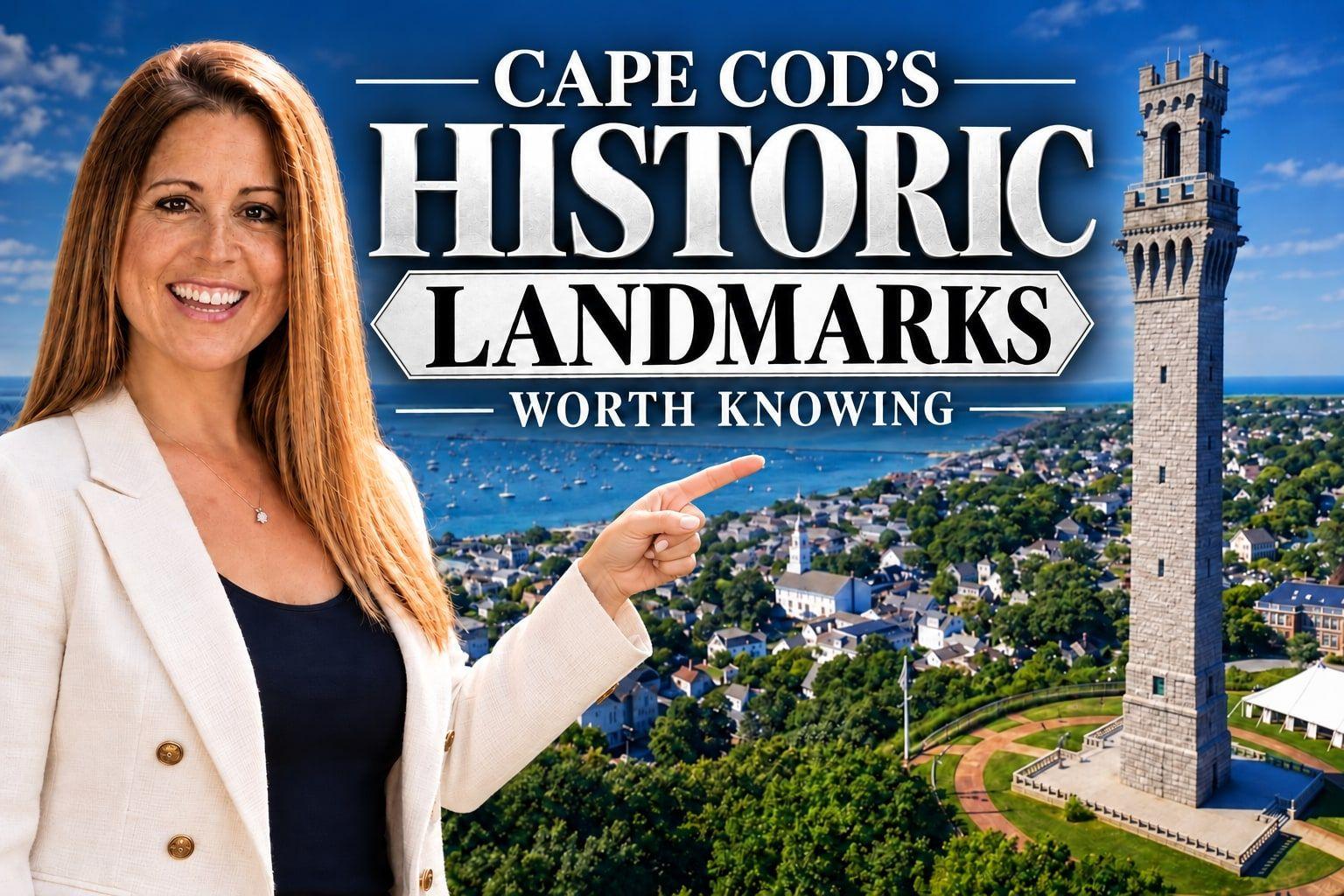
Provincetown's Pilgrim Monument was completed in 1910 and stands 252 feet tall, making it the tallest all-granite structure in the United States. It was built to fix a historical oversight: Plymouth had been getting all the credit for the Pilgrims' arrival. The monument is based on the Torre del Mangia in Siena, Italy, and you can still climb its 116 steps and 60 ramps to see the entire outer Cape on a clear day. The Pilgrim Monument and Provincetown Museum holds artifacts and documents that most Massachusetts history courses never cover.
A light station has stood at Nauset in Eastham since 1838, when the original three-tower "Three Sisters" lights went up. The current red-and-white tower was built in Chatham in 1877 and moved to Eastham in 1923. In 1996, it was moved again, about 336 feet back from the eroding cliff edge, because the bluff was disappearing at roughly three feet per year. The relocation was a significant engineering effort and a reminder that the Cape's coastline is not static. The National Park Service owns the lighthouse as part of Cape Cod National Seashore, and the Nauset Light Preservation Society maintains it.
The Old Indian Meetinghouse in Mashpee is the oldest Native American church in the eastern United States and the oldest church on Cape Cod. Its traditional date is 1684, though some historians argue the current building dates to 1758, and the National Register of Historic Places lists both dates. It was built for the Wampanoag people of Mashpee, who had been on this land for thousands of years before European contact. The building stands today on Meetinghouse Road. The Mashpee Wampanoag Tribe, federally recognized since 2007, holds reservation land in Mashpee and Taunton, and its continuous history on Cape Cod predates every other landmark on this list by millennia.
The Lighthouses People Overlook
Most visitors know Race Point Light and Highland Light, but Cape Cod has well over a dozen standing lighthouses, from Nobska in Woods Hole to Long Point at the tip of Provincetown, and several of them tell stories that go beyond scenic photography.
Highland Light in Truro, also called Cape Cod Light, is the Cape's oldest lighthouse, first lit in 1797, and its current tower is the tallest on the Cape. It sits on the Highland bluffs, which rise about 125 feet above the ocean and are among the highest cliffs on the Outer Cape. Henry David Thoreau made four trips to Cape Cod between 1849 and 1857, stayed at the lighthouse in 1850, and wrote about the keeper's life in his book Cape Cod. Like Nauset Light, Highland Light was moved back from the cliff edge in 1996 to save it from erosion.
Bass River Light in West Dennis was first lit in 1855. It went dark in 1880, was relit a year later after local complaints, and was finally decommissioned in 1914, the year the Cape Cod Canal opened. It became part of the Lighthouse Inn in 1938, and in 1989 the light was relit as a privately maintained aid to navigation. It's one of the few lighthouse structures in New England you can actually sleep in.
Why These Landmarks Matter to Cape Cod Residents Today
The historic landmarks worth knowing in Cape Cod aren't preserved as museum pieces. They sit inside or next to neighborhoods where people buy homes, raise children, and retire. The boundaries of Cape Cod National Seashore, established in 1961 under President Kennedy, directly affect what can and cannot be built in six towns: Provincetown, Truro, Wellfleet, Eastham, Orleans, and Chatham. If you own or are buying property in those towns, the Seashore's protected land shapes your views, your property's context, and in some cases your development rights.
The Mashpee Wampanoag Tribe's reservation land has had real legal and development implications for the town over the past two decades. Understanding the history of that land matters if you're following local planning decisions.
And the erosion that pushed two lighthouses back from the cliffs? That same erosion affects coastal property values and insurance across the Cape. The Cape Cod Commission publishes regional planning data that tracks shoreline change and development patterns. If you own waterfront property or are considering buying it, that data is worth reading.
History on Cape Cod isn't background. It's infrastructure.
For more on Cape Cod communities and what makes each town distinct, visit the Cape Cod communities guide guide.
Frequently Asked Questions
Where did the Pilgrims actually first land in America?
The Pilgrims first landed at Provincetown, at the tip of Cape Cod, in November 1620. They spent five weeks there before sailing to Plymouth. The Mayflower Compact was signed aboard the ship off Provincetown, and the Pilgrim Monument was completed in 1910 to mark that history.
Which Cape Cod lighthouse is open to the public?
Several Cape Cod lighthouses offer public access. Highland Light in Truro and Nauset Light in Eastham sit within Cape Cod National Seashore and open for tours seasonally. Race Point Light in Provincetown is reachable on foot or by oversand vehicle through the Seashore.
How does Cape Cod National Seashore affect local property owners?
Cape Cod National Seashore covers roughly 44,000 acres across six towns. Properties within or next to Seashore boundaries may face restrictions on development, renovation, and land use. Buyers and owners in Provincetown, Truro, Wellfleet, Eastham, Orleans, and Chatham should review Seashore boundaries and local zoning rules before making building or renovation decisions.
Sources
- Pilgrim Monument and Provincetown Museum
- National Park Service - Cape Cod National Seashore
- Mashpee Wampanoag Tribe
- Cape Cod Commission
Related reading
Available now